
Money you actually hold.
Bitcoin is digital money that settles without a bank in the middle. With Unseizable you hold it yourself — on-chain for savings, over Lightning for everyday spending. Here is how each part works, in plain language.
One Bitcoin, two ways to move it.
Bitcoin works on two layers. You don’t have to choose — Unseizable shows them as a single balance in Canadian dollars and picks the right rail for what you’re doing.
On-chain — the base layer
The main Bitcoin network. Transactions are recorded on the blockchain and settle on-chain, built for larger amounts and long-term holding — where final settlement matters more than speed.
Best for savings and larger transfers.
Lightning — the fast layer
A network built on top of Bitcoin for instant, low-cost payments. Funds move in seconds — the same bitcoin, just a faster rail for everyday-sized amounts.
Best for everyday spending and small transfers.
Either way it’s your bitcoin, your keys, and one balance in CAD.
When to use which.
Same bitcoin, two rails. Unseizable shows both as one balance and picks the right one for what you're doing.
| Feature | On-chain | Lightning |
|---|---|---|
| Settles in | ~10 minutes | Seconds |
| Typical fee | Varies with demand | Fractions of a cent |
| Best amount | Larger sums | Everyday amounts |
| Good for | Long-term holding | Coffee, tips, splitting a bill |
| Where it lives | On the blockchain | On top of Bitcoin |
| Self-custody | Yes | Yes |
On-chain
- Settles in
- ~10 minutes
- Typical fee
- Varies with demand
- Best amount
- Larger sums
- Good for
- Long-term holding
- Where it lives
- On the blockchain
- Self-custody
- Yes
Lightning
- Settles in
- Seconds
- Typical fee
- Fractions of a cent
- Best amount
- Everyday amounts
- Good for
- Coffee, tips, splitting a bill
- Where it lives
- On top of Bitcoin
- Self-custody
- Yes
Every fee shown in CAD, before you sign.
A network fee is what you pay the Bitcoin network to process a transfer — not a charge from us. On-chain fees move with demand, so we show the current estimate in plain CAD before you confirm. Lightning costs a fraction of a cent.
- EconomyWhen the network is quiet
- 280 sats
- StandardConfirms within the hour
- 620 sats
- PriorityNext few blocks
- 1,240 sats
Nothing moves until you confirm on your device — the keys never leave your phone.
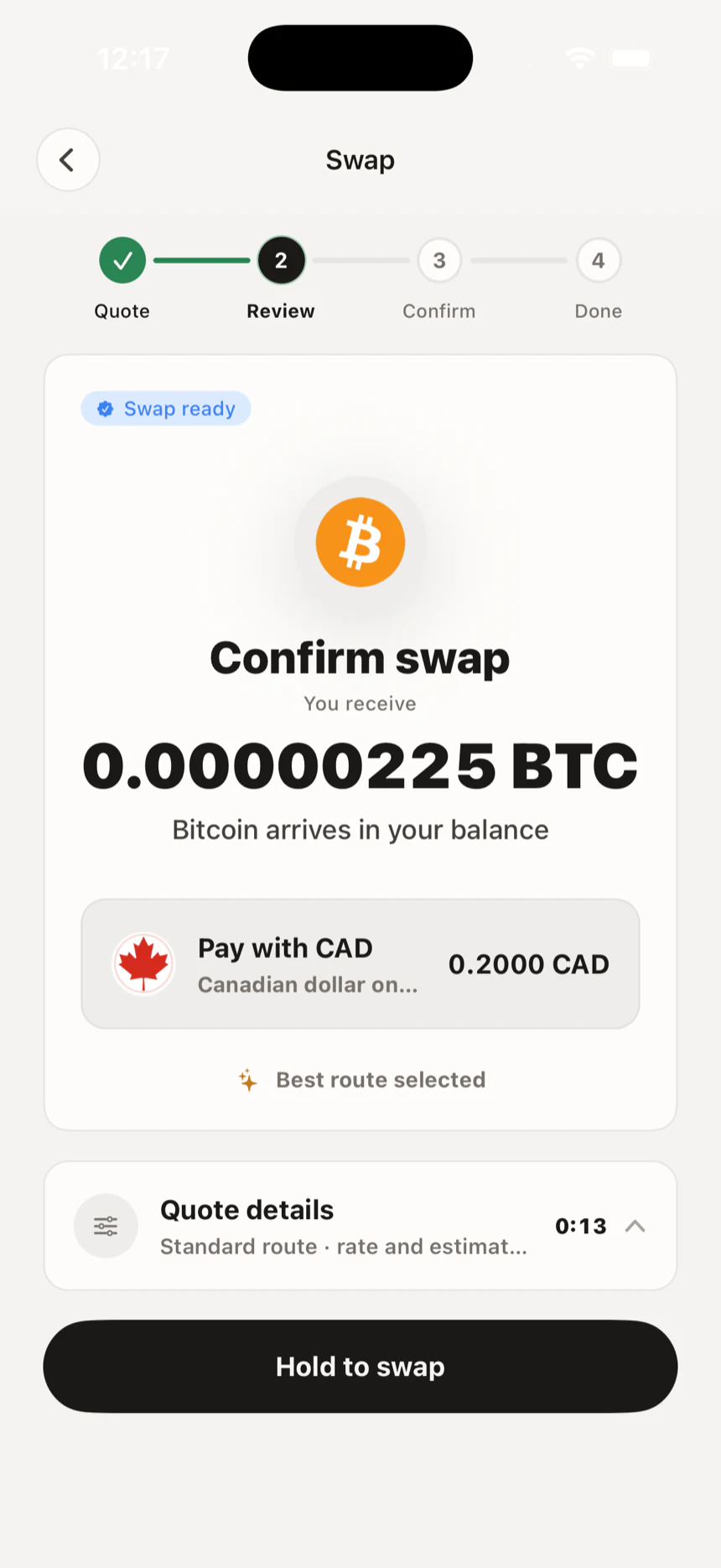
On-chain or Lightning, your keys never leave your phone.
Whichever layer you use, your private keys are generated and stored on your phone, protected by hardware-backed security. We’re non-custodial by design — you hold the keys, so you stay in control of your coins. As with any self-custody wallet, keeping your recovery phrase safe is your responsibility.
- Non-custodial by design
- Keys stay on your device
- Hardware-backed key storage
Bitcoin questions, straight answers.
They're two layers of the same Bitcoin. On-chain is the base network — transfers settle on the blockchain in roughly ten minutes and suit larger amounts. Lightning is built on top of Bitcoin for instant, low-cost payments, ideal for everyday spending. Unseizable shows both as one balance in CAD.
No. Unseizable picks a sensible rail and shows the network, amount, and fee in plain CAD before you confirm. The detail is there if you want it, but you don't have to think about it to send or receive.
On-chain fees rise and fall with how busy the Bitcoin network is — they're paid to the network, not to us. We show the current estimate in CAD before you confirm. Lightning fees are usually a fraction of a cent.
Yes. Your keys live on your device, not our servers. With your recovery phrase you can restore your wallet in any compatible wallet — we never take custody of your coins.
Hold Bitcoin the way it was meant to be held.
On-chain for savings, Lightning for everyday — with keys that stay on your device. Available on iOS and Android.
Free to download · iOS and Android · App Store and Play Store